Glossary
Money terms, in plain language.
Short definitions of the words you meet in statements, reports, GST and loans, with links to guides that go further.
36terms explained
23linked to a longer guide
18letters to jump between
Plainlanguage, no jargon
#
- 50/30/20 rule
- A budgeting guideline that splits take-home pay into about 50% needs, 30% wants and 20% savings. It is a starting point to compare against your real spending, not a fixed rule. Read the guide
A
- Account net position
- Money that came into an account minus money that went out over a period. A negative figure means the account paid out more than it received.
B
- Base currency
- The main currency a workspace reports in. Expenses in other currencies keep their original amount and are also stored in the base currency, so totals can be added up. Read the guide
- Billing cycle
- The period a credit card statement covers. The statement is issued at the end of the cycle and the payment is due a set number of days later.
C
- Category
- A label that groups similar spending, such as Food, Transport or Rent. Reports use categories to show where money goes. Categories can have sub-categories. Read the guide
- Credit limit
- The most a card issuer lets you owe on a credit card at one time.
- Credit utilisation
- The share of your credit limit that you are using, found by dividing the balance by the limit. A balance of ₹30,000 on a ₹1,00,000 limit is 30%. Read the guide
D
- Daily burn rate
- The average amount you spend per day over a period. It is total spending divided by the number of days.
- Debit and credit
- On a statement, a debit is money leaving your account and a credit is money arriving. In SpendixAI, debits are your expenses and credits are income, refunds and other money in.
- Duplicate transaction
- The same payment recorded twice, for example because a terminal retried or two overlapping statements were imported. Possible duplicates share an account, amount and merchant within a day or two. Read the guide
E
- Emergency fund
- Money set aside for unexpected costs such as a job loss or a medical bill. Many people aim for three to six months of essential expenses. Read the guide
- EMI
- Equated Monthly Instalment: the fixed amount you pay each month to repay a loan, covering both the principal and the interest. Read the guide
- Expense tracker
- An app that records what you spend, groups it into categories and shows reports, so you can see where your money goes.
F
- FIRE
- Financial Independence, Retire Early: an approach that relies on a high savings rate to build enough savings to stop depending on a salary earlier than usual.
- Foreign currency markup
- A percentage some card issuers add to the exchange rate when you spend in another currency. It is why the amount charged can differ from a currency website’s rate. Read the guide
G
- GST
- Goods and Services Tax: the indirect tax charged on most goods and services in India. The price you pay for a purchase usually already includes it.
I
- IMPS
- Immediate Payment Service: a way to transfer money between bank accounts instantly, at any hour. Read the guide
- Input tax credit (ITC)
- A credit for the GST a registered business has paid on its purchases, which can be set against the GST it owes, subject to the conditions in the law. Read the guide
M
- MCP (Model Context Protocol)
- An open standard that lets a supported AI assistant, such as Claude or ChatGPT, work with tools and data you choose to connect. In SpendixAI it lets an assistant read or, with permission, change your expense data. Read the guide
- Merchant
- The shop, business or person you paid. SpendixAI turns the text on your statement into a clean merchant name. Read the guide
- Merchant alias
- An alternative spelling of a merchant’s name. Adding aliases makes several statement spellings resolve to one merchant. Read the guide
N
- NACH
- National Automated Clearing House: the system behind automatic recurring debits such as loan EMIs, insurance premiums and some subscriptions. It replaced most use of the older ECS. Read the guide
- NEFT
- National Electronic Funds Transfer: an electronic bank-to-bank transfer used for ordinary payments. Read the guide
- Net cash flow
- Money in minus money out over a period. Positive means you took in more than you spent; negative means the reverse.
O
- Outlier
- An expense far larger than usual for its category. SpendixAI measures this with a z-score, which counts how many standard deviations an amount is above the category’s average. Read the guide
P
- Pareto principle (80/20)
- The idea that a small share of causes produces most of the effect. In spending, a few categories usually account for most of the total.
R
- Reconciliation
- Checking that your own records match the bank statement, line by line, so nothing is missing or double counted.
- Recurring payment
- A charge that repeats on a schedule, such as a streaming plan, a gym membership or an EMI. Also called a subscription when it is for a service. Read the guide
- RTGS
- Real Time Gross Settlement: a bank-to-bank transfer for large amounts, settled individually and in real time. Read the guide
S
- Savings rate
- The share of your income that you keep: (income − expenses) ÷ income. Earning ₹90,000 and spending ₹66,000 gives a savings rate of 26.7%. Read the guide
- Statement import
- Uploading a bank or card statement, as a PDF, CSV or Excel file, so SpendixAI can read the transactions and add them after you review them. Read the guide
T
- Tax-deductible expense
- A cost that tax rules allow you to subtract from your taxable income. Which expenses qualify depends on the law and your situation, so confirm with your CA.
- Transaction narration
- The short text your bank prints beside a payment, such as “UPI/4821903/SWIGGY”. It usually holds the merchant and a reference. Read the guide
U
- Uncategorised transaction
- A transaction that has no category yet. Until it is sorted, it cannot be counted in category reports. Read the guide
- UPI
- Unified Payments Interface: an Indian system for instant payments between bank accounts from a mobile app, using a UPI ID or a QR code. Read the guide
W
- Workspace
- Your own space in SpendixAI that holds your accounts, transactions, categories, reports and settings. Each workspace’s data is kept separate from every other.
Go deeper
Guides behind the terms
Savings rate explained: the one number that shows if you are getting ahead
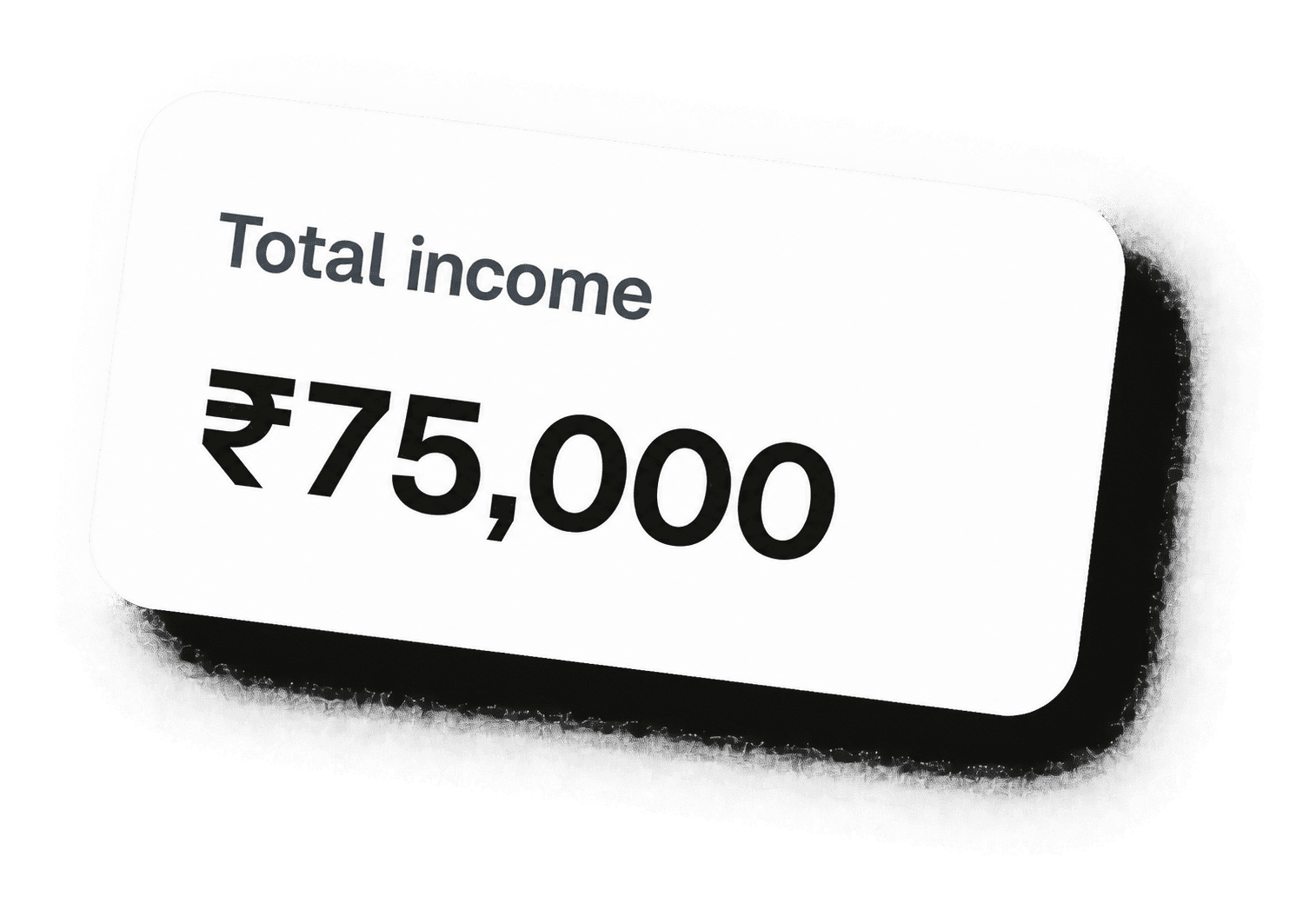
Your savings rate is the share of income you keep. Learn the formula, how to calculate it from real transactions and what moves it.
Read article
Tracking GST and input tax credit on business expenses
How to keep GST-inclusive spending organised so you can see the tax inside each purchase and hand your CA a clean record.
Read article
How to read your bank statement: UPI, NEFT, IMPS and other narrations
Statement lines such as UPI, NEFT, IMPS, NACH and POS look cryptic. Here is what each one means and how to find the merchant inside.
Read articleSee them in your data
These terms, applied to your own spending
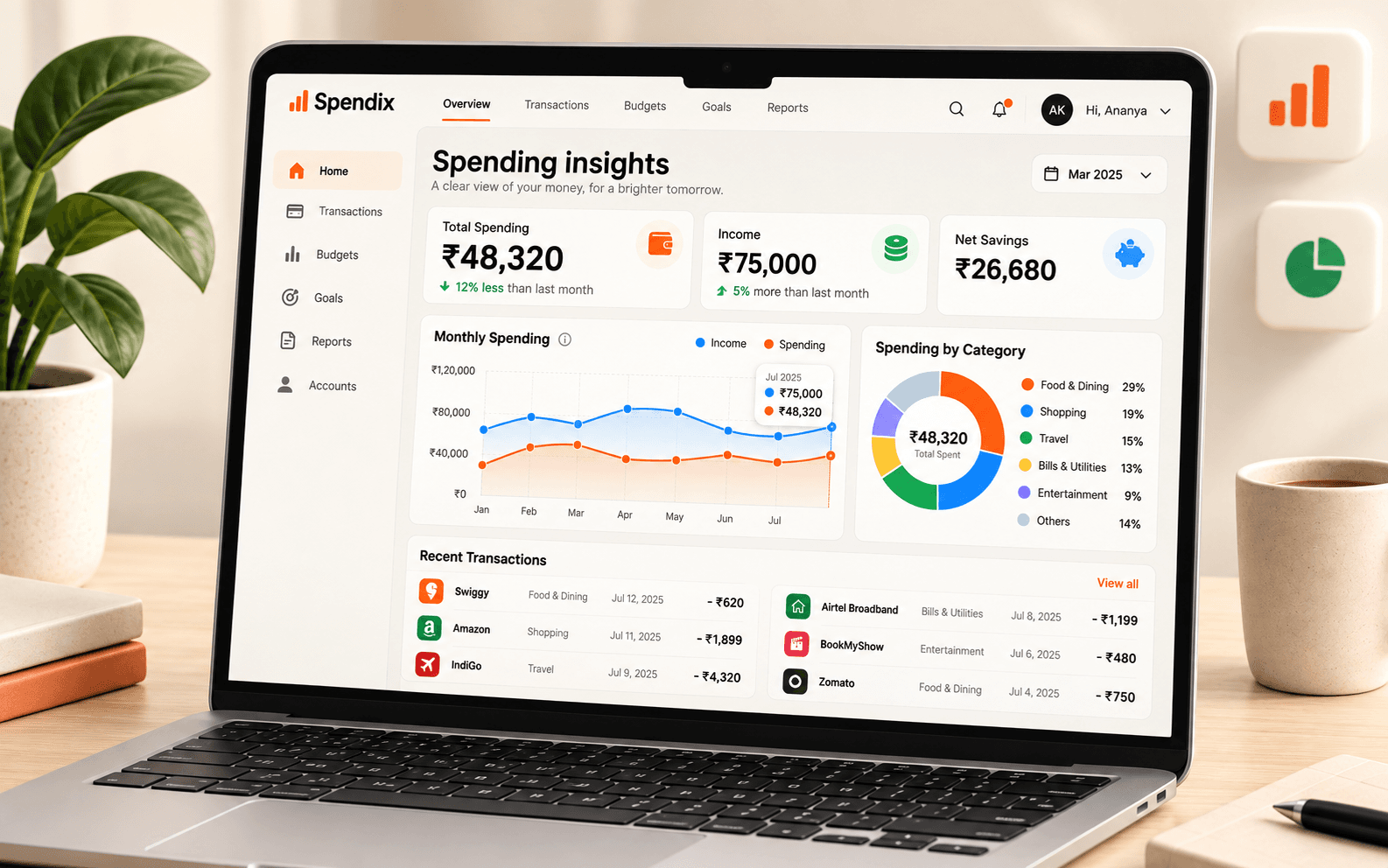
Definitions help, but numbers from your own statements make them stick. Import a statement and the Report library shows most of these terms for you.
- Savings rate and net cash flow, month by month.
- GST and ITC-eligible spend, by category.
- EMI burden and credit-card fees.
- Duplicate and outlier checks.
Ready to start?
Get started See these terms in your own spending.
Import a statement and open the Report library.